BLOG
3D Camera Technologies Comparison: Differences Between Structured Light, ToF, and Stereo Vision
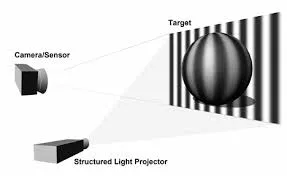
In industrial automation, choosing the right 3D camera directly determines the success of the project. However, the variety of technologies on the market makes decision-making challenging. Structured Light, Time-of-Flight (ToF), and Stereo Vision - these three fundamental approaches offer different advantages. So which one is right for your application?
Structured Light: The Gold Standard of Precision
Structured Light technology creates a depth map by projecting a known light pattern onto the surface. By analyzing the deformation of the pattern on the surface, micron-level measurements are obtained. This method is particularly prominent in bin picking, quality control, and precision assembly applications. Scanners like Photoneo's PhoXi series produce stable point clouds even on reflective and dark surfaces. Its disadvantage is that scanning speed can be lower compared to other methods.
Time-of-Flight (ToF): Speed and Wide Coverage
ToF cameras calculate depth by measuring the return time of light sent to the surface. Their greatest advantage is speed - they can capture hundreds of frames per second. They are ideal for wide working areas, AGV navigation, and human detection systems. However, precision is lower compared to Structured Light, and they can be affected by external factors such as sunlight.
Stereo Vision: Flexibility and Cost Advantage
Similar to the working principle of the human eye, it uses the parallax difference between two cameras. It performs well on texture-rich surfaces and has a wide working range. Mech-Mind's Mech-Eye series combines stereo vision with AI algorithms to deliver high performance in industrial environments. However, it may require additional lighting on textureless or uniform surfaces.
Which Technology Should You Choose?
The choice depends entirely on application requirements. If micron-precision measurement is needed, Structured Light leads; if high speed and wide area coverage are the priority, ToF stands out; if cost-performance balance is sought, Stereo Vision takes the lead. In many modern industrial systems, these technologies are also used in hybrid configurations.
As MIS Automation, we offer a range of 3D imaging solutions from our global technology partners including Photoneo, Mech-Mind, Solomon, and OPT. Contact our team to determine the most suitable technology for your application together.